Thursday, November 1, 2012

Designers, Visionaries, and Other Stories: Chapter 4 summary

Chapter 4 of Designers, Visionaries, and Other Stories is called "Design Redux". The book is a little dated so some of the information is a little bit off but for the most part is fairly accurate. It is all about ways to utilize old products in new and interesting designs and cut down the waste that is generated in the country from a consumer society. Design is changing but on a very personal level, or a contemporary level. The change is happening because of environmental and moral reasons. However, the changes are not affecting mainstream industrial design. Industrial design lends itself more towards conservative methods and structure. Outside of that field, the more contemporary designs are more enabling, approachable, expressive and engaging. It answers the question "How can we live decently?" It has an emphasis on intuitive, hands-on, physical and reciprocal methods. These methods are a reaction to the world and play off of the idea of reduce, reuse, recycle. The chapter then goes into different ways to approach design with the contemporary ideas in mind.

Appreciation

The section starts off with the author talking about an email he got from his friend who had just gotten back from India. The friend says how he never knows what to say when someone asks how a trip was because you never come back the same. He then leads into a discussion about appreciation. Appreciate what we already have, this is a prominent part of the new style of design. This new style of design is evident projects such as the Sear's Style Project, the Salvation series, and the Banquette and Alligator chairs by the Campana brothers. These projects go against the flow of mass production methods that are typically environmentally and socially harmful and also wasteful and damaging. Dissatisfaction in the rich countries is what gives consumerism and mass production design fuel and in turn, that contributes the environmental destruction. Some contemporary designers are trying to fight the consumerism and trying to "reconcile" ethical and environmental concerns. This will help to reduce the negative consequences of the problem. This all leads back to the saying appreciate what we already have!

Design Redux

Redux is a 17th century word that means to bring back or restore. In 2001 Francis Coppola used to word to describe when he remade is film Apocalypse Now. The new version of the movie gave the public the opportunity to re-appreciate what they already had. Through re-presenting old products, we will be able to restore them as contributions to the human culture and show appreciation and respect to the things they were. We give the products a new life and a chance for them to contribute to economic interests while also cutting down on waste and use of materials. Jurgen Bey is a designer that took this aspect and put it to use. He did this through his glass and polyester infused chairs and his chandelier made from cylinders of two-way mirror foil. Also the Bootleg series by Wolf, Bader, and Oschtz was another way of doing this. They took old music equipment and redesigned it to play MP3 files. This method of design is a way for people appreciate still functioning but out-of-date products.

Distributed and Shared Creativity

This part of the chapter starts off with a great quote, "Everyone is smarter than anyone." Big things can happen when people put their heads together and collaborate. Great examples of this idea being put to use are Wikipedia, Linux, and Mashup. Granted they have some flaws but they are all successful websites though. Story telling also demonstrates this idea. The method of passing stories through generations gives everyone a chance to put their ideas and twist on it. They evolve with the people as it goes from person to person. These ideas are alive and well in contemporary design but not in mainstream design. If it was used in mainstream design, things would change based off of the location and the type of people involved. This would help overcome the idea of a passive consumer and can bridge the gap between traditional and industrial design.

Design Approach

This section of the chapter talks about how Canada throws out about 272,000 electronics every year and they talk about challenges of creating a design approach to help shrink that number. Theres problems with the variety of electronics thrown out and the time and money it would take to break down the stuff. That would create waste in itself. These things follow Thackara's seven design frameworks.
  1. sense and respond
  2. deep context
  3. seeding edge effects
  4. smart recombination
  5. social fiction
  6. designing with us
  7. design as service
When it comes to music, remixing is a great design approach. It gives a new twist on an older song and makes people re-appreciate it. Cirque du Soleil did this for one of their shows. They mashed up and remixed a bunch of Beatles songs called it The Beatles Love Cirque du Soleil. 

Harvesting the Discarded

This section starts of talking about how re-using discarded products in a way that could be adapted to fit any culture. This means making as little changes to the product as possible to leave the opportunities open. They then go on to talk about ways to assemble and display the piece. You could use take old wine bottles and place a light and lamp shade in the top of them and end up with an interesting new lamp. You could also use old radios or cassette players and alter them so they can play MP3 files. These things could then be mounted on a square board and presented in interesting ways. The square frame gives the objects a whole new life.

Re-valuing Objects

There are different types of "value" to things and Walker and Chaplin made a list of these:

  1. Artist value - aesthetic quality and significant content
  2. Uses value - the functionality and purpose of the object 
  3. Sentimental value - emotional life of an object to an individual 
  4. Exchange value - the actual monetary value 
These four things listed above are very much dependent upon each other. When one of the values gets affected, then most likely the others will be too. Say the object loses it functional quality, then the use value of it decreases. When the use value goes down, the exchange values also goes down because no one will want something thats broken. A way to combat this is to give the object a new function and way to used. Doing that will make the values stay relatively the same and therefore RESTORING the values of the object

Friday, October 19, 2012

What this Country has come to....


It is really a shame that this is what the country has come to. There are people all over that don't have nearly half of what we do and yet we still complain about what we have and find a way to make it sound justified. Maybe the way it is portrayed in this video is comedic but it is just sad that the reactions in it are pretty much true. Just some food for thought

NY Times Articles

The BlackBerry as the Black Sheep: Oct. 17th

The once powerful and dominate company BlackBerry has seemed to fall to waste side in the smart phone race that has taken over the nation. According to New York Times, the percentage of BlackBerry users at a 10th of a precent from what it was 3 years ago (currently 5%). That means bad things for RIM, the software provider for BlackBerry. Major companies, and even the White House, have been switching their phones to iPhones or android phones. One saving grace to the BlackBerry is the presence of a PHYSICAL keyboard. Other than that, there isn't really too much they have going for them.

This article topic is very prevalent in my life right now. I have many friends that have traded in their BlackBerry, which the term CrackBerry was starting to be used, for iPhones and Droids. I have never had a one myself but I know that I glad I haven't just because of all the problems and horror stories I've heard.


Hey, That's My Ethics Professor Cursing Up There on the Stage: Oct 19th

Business students got a rude awakening in their business ethics class at Fairfield University. The typically relaxed and practical professor was not that in the least. In a collaboration between the art and science school and business school, professor Schimdt read a very explosive and forward monologue from Glengarry Glenn Ross that was rich with profanity. Needless to say, the students surprised, caught of guard, and a little bit nervous about the outburst. The meaning behind it was to give them a look into the real world of business and prepare them for situations they might be faced with.

When I read this article I couldn't help but laugh some. It is not uncommon to find my professors slipping a few curse words into their lectures and have them be very blunt about what life will be like after college. So naturally I found it funny that people would have a nervous, appalled, and taken back reaction to seeing their professor like that. But I also think it was a GREAT idea because it gives the students a first hand look at what they face after they graduate.

Thursday, September 27, 2012

Sticker Project

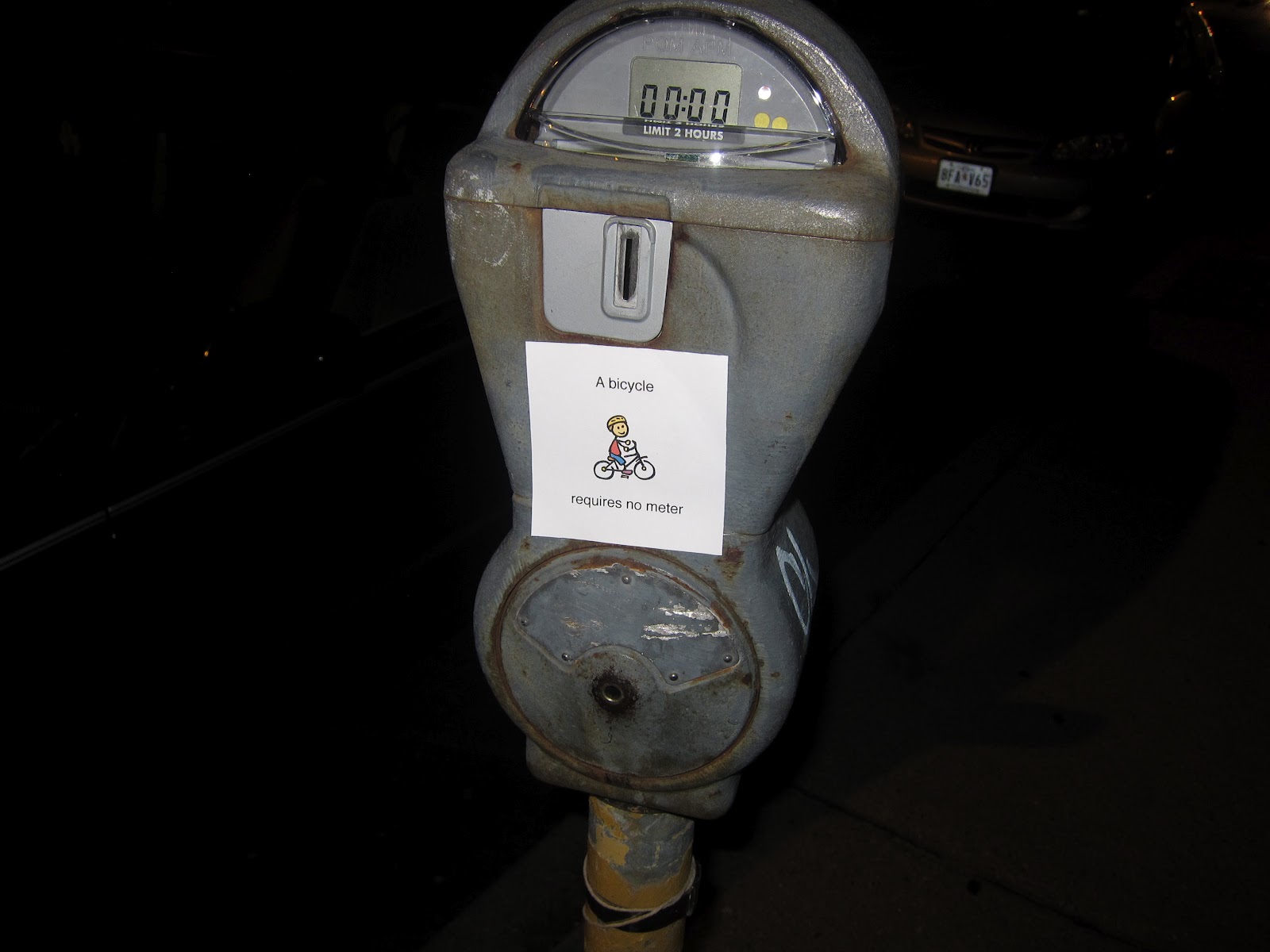
I used the issue of parking in Baltimore for my project. I wanted to address the fact that there is very free limited free parking in the city and there also a lot of meters/pay stations around. I wanted to try to make people aware of how much they spend on the meter and other forms of transportation that is cheap and also free. I ended up putting stickers on the meters and pay stations the had facts and comments about parking.


 Here are some pictures of the stickers i used and how I put them on the meters. I made sure I didn't cover anything that was important like writing and the pay slot. I also made it easy for them to be taken off in need be.


Results:

I wanted to see some immediate responses to my project but the time that I did it kind of inhibited that. I did see a few people checking out and reading my stickers but when I stopped to take a pic they were either done or stopped reading and walked away. I was also asked what i was doing and if I was giving out tickets to people. I want to go back down and see if my stickers are still there or if people are actually looking at them.


Wednesday, September 19, 2012

Guerrilla Project

Social Issue:

The social issue I am going to base my first project off of is parking in the city. Parking is a very big issue every time I go into the city. There is never anywhere to park and you always waste a good amount of gas driving around trying to find a spot. Once you find one you have to put money in the meter so you not only waste gas but money too. There are a lot of spots where you cant park at all or you can only park between certain hours. So I am planning on making stickers to go around and put on meters and pay stations. These stickers will have facts and different comments on them about parking in cities and gas.

Some of the facts and comments would include:

  • The average person spends $368 on gas a month.
  • The money spent on this meter goes to help pay the salary of the person who would write you a ticket.
  • That change would look a lot better going in a coinstar machine.
  • No meter needed for a bike.
  • This meter costs the same amount as a bus fare.
things of this nature to get peoples attention and spark interest in other means of transportation. I would use typography to make the stickers appealing so people will want to read them.


Wednesday, September 12, 2012

Guerilla Art. What is it?!

What is it?

Guerilla art is often considered street art. It is a form of art where an anonymous artist leaves their piece in a public place as a way to express their views on certain topics and make an overt public statement. It started as an "underground" movement in the 80's. It doesn't use just one medium, it could use whatever type of expression that you want. It is often highly controversial and is meant to be very thought provoking to who every comes across it. Common forms of guerilla art are:


  • Chalking
  • Sculptures 
  • Stickers
  • Posters
  • Graffiti 


"Its good for people to remember that public space is a battleground, with the government, advertisers and artists all mixing and mashing, and even now the cross-pollination taking place as street artists become brands, and brands camouflaging as street art creating complex hybrids or impersonators." 
- Mark Jenkins


Top Ten Social Issues
  1. Parking 
  2. Instant Gratification
  3. Trash on the streets
  4. Profiling
  5. Neglected Neighborhoods
  6. Harbor Water Quality
  7. Need for Monetary Exchange
  8. Abandoned Houses 
  9. Safe Places for Kids
  10. Homeless

Wednesday, September 5, 2012

Design Thinking

There are many different ways to define what design thinking is, but i feel these two fit it best. Design thinking is the process of practical, creative resolution of problems or issues that looks for an improved future result.  A discipline that uses designers sensibility and methods to match peoples needs with what is technologically feasible and what a viable business can convert into customer value and market opportunity.
http://designthinking.ideo.com/?p=49
http://en.wikipedia.org/wiki/Design_thinking

Here is a list of others ways to define design thinking : http://mootee.typepad.com/innovation_playground/2012/02/design-thinking-is-a-cognitive-and-intellectual-process-that-balances-the-rational-and-emotional-not.html

My understanding of "design skills" is that it is a way to measure the creative and personal abilities of a person when it comes to design. It doesn't have to be just with artistic design. It could lend itself to businesses, sports, journalism, television, and many other things. It can measure the ability of a persons way of communication an idea to someone as well.

Creativity, to me, is when someone puts their own spin and personality on something to make it unique and interesting to a large group of people. Creativity is something that comes naturally to every person. It's how we access that part of the brain and utilize that style of thinking that makes it more noticeable in certain people. Creativity is important to the success of a person because it is something that will set them apart from the rest of the people in their specific field. The webster style definition of the word is: the ability to transcend traditional ideas, rules, patterns,relationships, or the like, and to create meaningful newideas, forms, methods, interpretations, etc.; originality,progressiveness, or imagination.
http://dictionary.reference.com/browse/creativity